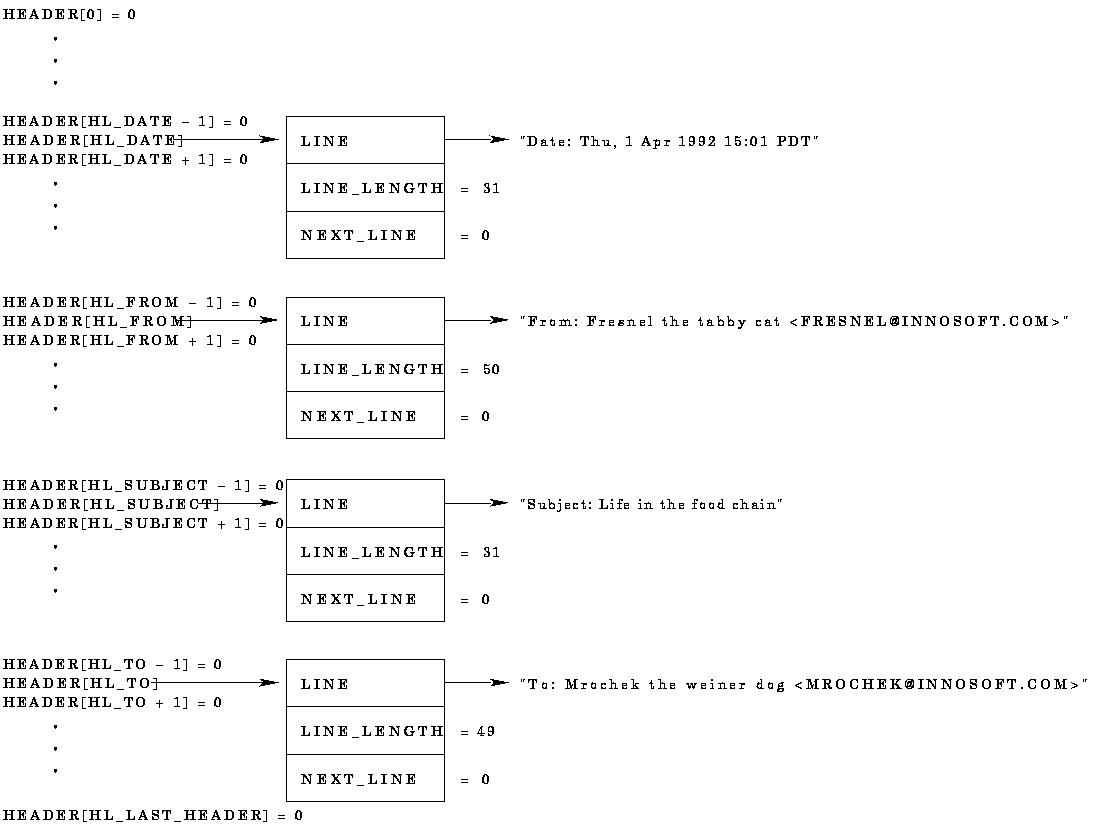
The header structure is an array of pointers to header line structures whose format is described below. Each entry in the array describes a particular type of header line. The HL_ constants defined in the API include files are indices into this array.9 For instance, suppose that the message header of Example 1-1 is read with PMDF_read_header and stored in a header structure pointed at by the pointer variable HEADER. Then the header structure would appear as shown in Figure 1-1
Figure 1-1 Sample header structure
After reading in a message header with PMDF_read_header, a program may
"probe" to see which header lines were specified in that
message header by checking to see if the corresponing entry in the
header structure array is zero (nil) or not. For instance, if
HEADER[HL_REPLY_TO] is zero, then no Reply-to: header line was present
in the message header. From C, the ith entry in a header structure
would be referenced using the syntax (*hdr)[i];
e.g.,
(*hdr)[HL_DATE]->lineFrom Pascal, use
hdr^[i]; e.g.,
hdr^[HL_DATE]^.lineThe routine
display_header_lines in Examples 1-8
and 1-9 illustrates how to walk through a header structure.
Now, the format of a header line structure is shown Figure 1-1 . (Indeed, four header line structures are shown in that figure.) Each header line structure has three fields which are as follows:
LINE
A pointer to the header line. The header line is a null terminated character string of length LINE_LENGTH bytes. The quotes shown surrounding each header line in Figure 1-1 are not part of the header line; they are merely shown in that figure to indicate that a character string is being depicted.LINE_LENGTH
A signed longword (4 bytes) containing the length of the character string pointed at by LINE. This length does not include the null terminator at the end of the string.NEXT_LINE
A pointer to any additional header line structures describing header lines of the same type. When zero, indicates that no additional header lines of the same type exist.
The NEXT_LINE field is the mechanism which enables more than one header
line of a given type (e.g., Received:, Comments:, Keywords:,
etc.) to be stored in a header structure. For instance, if two
Comments: header lines are stored in a header structure, then the first
one is accessed with
HEADER[HL_COMMENTS]-->LINE and the second one with
HEADER[HL_COMMENTS]-->NEXT_LINE-->LINE So, each entry in the
header structure array is actually the pointer to the head of a linked
list of header lines. Each header line in a given list is of the type
corresponding to the index in the header structure array. That is, each
header line in the linked list HEADER[HL_x] is of type
HL_x. The order in which the header lines appear in the linked
list are the order in which they were added to the header structure:
the first header line in the list is the first one added, the second
one is the second one added, and so on. Header lines added to a
structure by PMDF_read_line are added to the structure in the order in
which they are read from a message header. Thus, the first Received:
line in a header is the first one added by PMDF_read_line, the second
Received: line the second one added, and so forth.
Note
9 These constants are defined in the
files apidef.h and apidef.pen. The C header
file apidef.h is located in the PMDF_COM:
directory on OpenVMS and the /pmdf/include directory on
UNIX and NT. The Pascal environment file apidef.pen is
located in the PMDF_EXE: directory on OpenVMS.
Previous | Next | Contents