The strings passed as input to the C format API routines need not be zero terminated; the API routines ignore any zero terminators and exclusively use the associated length argument when determining the strings length. On output, however, the C format API routines will always add zero terminators to output strings as well as return the strings' lengths in the associated length arguments.
1.13.1 Summary of routines
Table 1-1 summarizes the routines included in the PMDF API.
| Enqueue routines | Description |
|---|---|
| PMDF_enqueue_initialize | Prepare for one or more message enqueues |
| PMDF_start_message_envelope | Begin a message enqueue context; specify the envelope From: address |
| PMDF_set_envelope_id | Set the envelope id for the message |
| PMDF_set_recipient_type | Specify if an address is a To:, Cc:, or Bcc: address |
| PMDF_set_recipient_flags | Set NOTARY flags for next envelope recipient address |
| PMDF_alias_no_expansion | Inhibit expansion of aliases; generally, this routine should not be used |
| PMDF_add_recipient | Specify To:, Cc:, and Bcc: addresses |
| PMDF_start_message_header | End the message envelope and begin the message header |
| PMDF_write_date | Output a Date: header line |
| PMDF_write_from | Output a From: header line |
| PMDF_write_subject | Output a Subject: header line |
| PMDF_write_header | Output a header structure |
| PMDF_start_message_body | End the message header and begin the message body |
| PMDF_write_line | Output a line to the message header or body |
| PMDF_write_text | Output a text string to the message header or body |
| PMDF_enqueue_message | End the message and enqueue it; dispose of the message enqueue context |
| PMDF_abort_message | Abort a message and dispose of the message enqueue context |
| PMDF_receipt_control | Control the use of delivery and receipt request headers |
| PMDF_set_limits | Set message size limits used to fragment messages |
| PMDF_set_receipt_addresses | Set delivery and read receipt request addresses |
| Dequeue routines | Description |
| PMDF_dequeue_initialize | Prepare for one or more message dequeues; create a dequeue context |
| PMDF_get_message | Access a queued message; return the envelope From: address |
| PMDF_get_envelope_id | Get the message's envelope id |
| PMDF_get_message_id | Get the message's message id |
| PMDF_get_recipient | Read the next envelope To: address |
| PMDF_get_recipient_flags | Obtain NOTARY flags for previous envelope recipient address |
| PMDF_copy_message | Copy the queued message to a new message being enqueued |
| PMDF_recipient_disposition | Specify the disposition of a recipient address. |
| PMDF_read_header | Read the header of a message |
| PMDF_read_line | Read a line from a message; line feed record terminator is stripped by API |
| PMDF_read_text | Read a line from a message; line feed record terminator is not stripped by API |
| PMDF_read_failure_log | Read a line from the message delivery failure log, if present |
| PMDF_rewind_message | Go back to the start of the message header |
| PMDF_dequeue_message_end | Remove a message from the message queue |
| PMDF_dequeue_end | Dispose of a message dequeue context |
| Address parsing | Description |
| PMDF_address_parse_list | Parse a list of address producing an address context |
| PMDF_address_get | Extract an individual address from a list of parsed addresses |
| PMDF_address_get_property | Extract a property of an individual address from a list of parsed addresses |
| PMDF_address_dispose | Dispose of an address context |
| PMDF_get_address_property | Parse an address and return the specified property |
| Option file processing | Description |
| PMDF_option_dispose | Dispose of an option file context |
| PMDF_option_get_integer | Obtain the value associated with an integer-valued option |
| PMDF_option_get_real | Obtain the value associated with a real-valued option |
| PMDF_option_get_string | Obtain the value associated with a string-valued option |
| PMDF_option_read | Process an option file |
| Miscellaneous routines | Description |
| PMDF_abort_program | Abort the currently running program |
| PMDF_add_header_line | Add a header line to a header structure |
| PMDF_address_to_channel | Return the name of the channel to which the specified address rewrites |
| PMDF_cancel_call_back | Cancel any call backs |
| PMDF_channel_to_host | Return the official host name associated with a channel |
| PMDF_close_log_file | Close the PMDF log file |
| PMDF_close_queue_cache | Close the queue cache database |
| PMDF_debug | Set enqueue and dequeue debugging flags |
| PMDF_database_add_entry | Add an entry to a database |
| PMDF_database_close | Close a database |
| PMDF_database_delete_entry | Remove an entry from a database |
| PMDF_database_get_entry | Lookup an entry in a database |
| PMDF_delete_header_line | Remove a header line from a header structure |
| PMDF_dispose_channel_counters | Dispose of a list of channel counters |
| PMDF_dispose_header | Dispose of a message header structure |
| PMDF_done | Deallocate PMDF data structures and resources |
| PMDF_get_block_size | Obtain the size in bytes of a PMDF block |
| PMDF_get_channel_name | Obtain the current channel name |
| PMDF_get_channel_counters | Obtain channel counters |
| PMDF_get_error_text | Obtain information about a recent error message |
| PMDF_get_date_time | Obtain the current date and time |
| PMDF_get_host_name | Obtain the official local host name |
| PMDF_get_postmaster_address | Obtain the local postmaster's address |
| PMDF_get_unique_string | Obtain a unique string suitable for use in filenames |
| PMDF_get_user_name | Obtain the current user name |
| PMDF_host_to_channel | Return the name of the channel associated with the specified host name |
| PMDF_initialize | Initialize PMDF data structures and resources |
| PMDF_log | Write a line of text to a channel log file |
| PMDF_mapping_apply | Map a string with a mapping table |
| PMDF_mapping_load | Load a mapping table |
| PMDF_queue_cache_end | Dispose of a queue cache context created with PMDF_queue_cache_get_entry |
| PMDF_queue_cache_get_entry | Retrieve an entry from the queue cache database |
| PMDF_set_call_back | Establish a call back routine |
| PMDF_set_mutex | Provide mutex handling routines |
| Obsolete routines | Description |
| PMDF_dequeue_message | Remove a message from the message queue; superceded by PMDF_recipient_disposition and PMDF_dequeue_message_end |
| PMDF_defer_message | Defer a message for later reprocessing; superceded by PMDF_recipient_disposition and PMDF_dequeue_message_end |
| PMDF_return_message | Return a message as undeliverable; non-NOTARY style format; superceded by PMDF_recipient_disposition |
1.13.2 Order dependencies
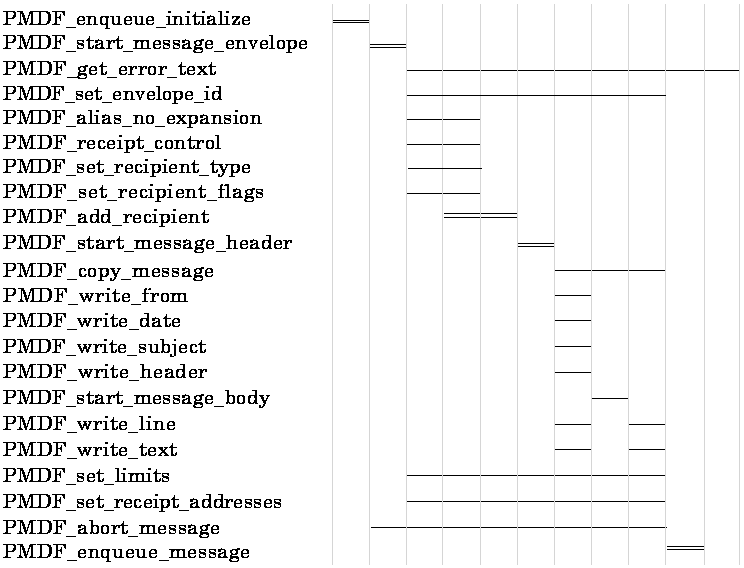
Figure 1-2 visually depicts the calling order dependency of the
message enqueue routines. To the right of each routine name appears a
horizontal line segment, possibly broken across a column
(e.g., PMDF_write_line, PMDF_write_text). Routines for which
two horizontal line segments, one atop the other, appear are required
routines --- routines which must be called in order to enqueue a
message. These routines are PMDF_enqueue_initialize,
PMDF_start_message_envelope, PMDF_add_recipient,
PMDF_start_message_header, and PMDF_enqueue_message. Now, to determine
at which point a routine may be called, start in the leftmost column
and work towards the rightmost column. Any routine whose line segment
lies in the first (leftmost) column may be called first. Any routine
whose line segment falls in the second column may next be called after
which any routine whose line segment falls in the third column may be
called, etc., etc.. When more than one routine appears in the
same column, any or all of those routines may be called in any order.
Progression from left to right across the columns is mandated by the
need to call the required routines. Note that of the required routines,
only PMDF_add_recipient may be called multiple times for a given
message.
It is assumed in Figure 1-2 that PMDF_initialize is first called before any other API routines. If more than one message is to be enqueued, PMDF_enqueue_initialize should only be called once, at the start of the first message.
Figure 1-2 Calling precedence for the API message enqueue routines
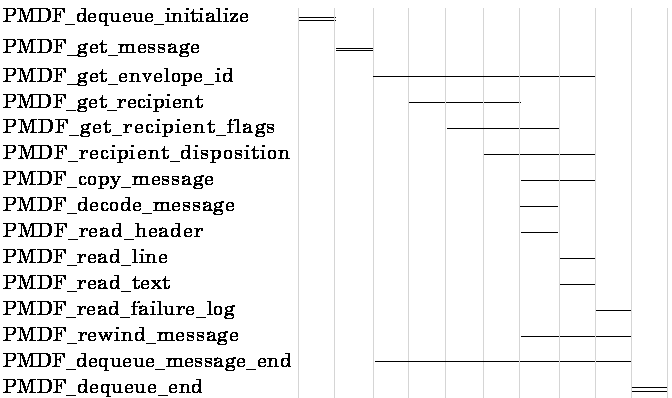
Similarly, Figure 1-3 visually depicts the calling order dependency of the message dequeue routines. In that figure, the required routines are PMDF_dequeue_initialize, and PMDF_get_message.
In Figure 1-3 , it is assumed that PMDF_initialize is first called before any other API routines. If more than one message is to be dequeued, PMDF_dequeue_initialize should only be called once, at the start of the first message. PMDF_get_message should be called repeatedly until the status code PMDF__EOF is returned at which point there are no more messages to be processed. Note that after calling PMDF_rewind_message, the message is rewound to the start of the message header and PMDF_read_header may again be called (i.e., you're back in the sixth column counting from the left).
Figure 1-3 Calling precedence for the API message dequeue routines
1.13.3 Strings passed to and from the API
As mentioned previously, the API presents two call formats: one which
uses OpenVMS-style string descriptors and another which uses C's style
of passing a pointer to a string. For multi-platform code, use the C
style interface.
When using the C-style interface, strings passed in need not be zero terminated: the length of the string is always determined from an associated argument specifying the length of the string. When a string is passed in which will be written to, on output the string is always zero terminated and its length, not including the zero terminator, returned in an associated length argument. On input, this length argument must give the maximum length of the string, not including the space used by a zero terminator.
Although strongly discouraged, the VMS-style interface which uses OpenVMS string descriptors may be used on UNIX as well as OpenVMS. Under UNIX the DSC$B_DTYPE and DSC$B_CLASS fields of descriptors are ignored by the API; all descriptors are treated as static character string descriptors (DSC$B_CLASS = DSC$K_CLASS_S; DSC$B_DTYPE = DSC$K_DTYPE_T).
There are basic string sizes used by the API. Their symbolic names and their values in PMDF V6.0 are shown in Table 1-2 . As these sizes are subject to change, programmers are encouraged to use the constants defined in the supplied include files described in Section 1.11 .
| Symbolic name | Value |
|---|---|
| ALFA_SIZE | 252 |
| BIGALFA_SIZE | 1024 |
| CHANLENGTH | 32 |
| DATA_LENGTH | 80 |
| KEY_LENGTH | 32 |
| LONG_DATA_LENGTH | ALFA_SIZE |
| LONG_KEY_LENGTH | 80 |
| SHORTALFA_SIZE | 40 |
1.13.4 Routine descriptions
This section documents the PMDF API routines.